

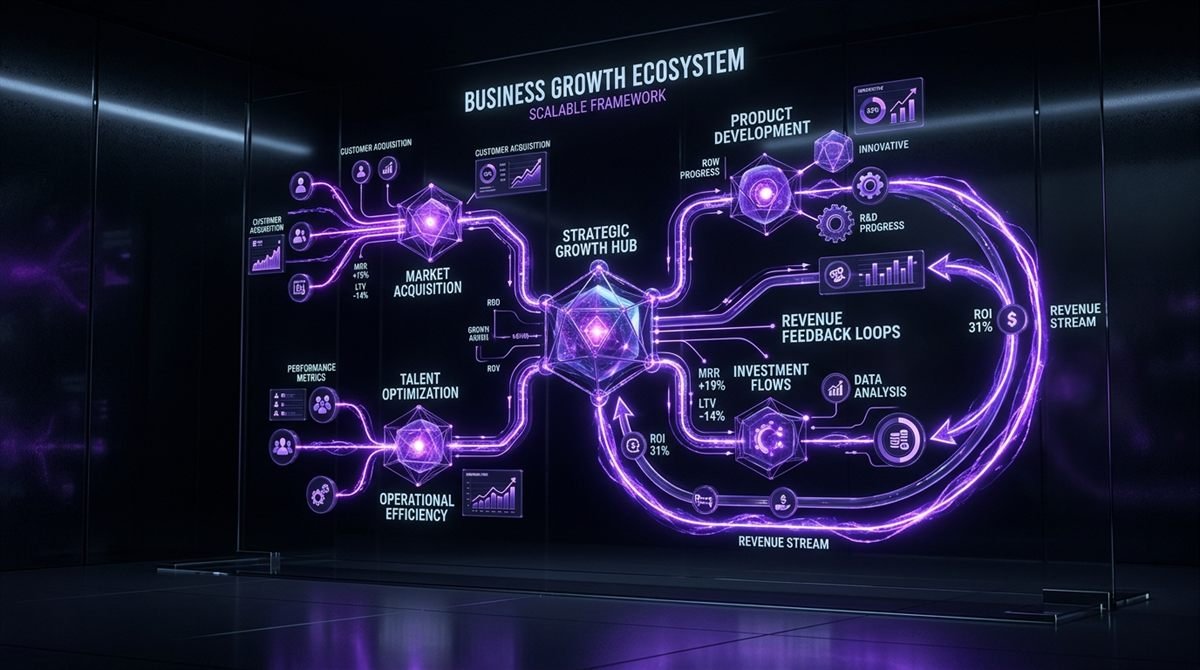
Most businesses do not suffer from a lack of marketing activity. They suffer from disjointed tools, competing agendas, and fragmented customer journeys that fail to compound over time.
The Illusion of Activity
When revenue slows, the default reflex for many executive teams is to purchase more traffic. They commission a new ad campaign, hire an influencer, or publish twenty generic social media graphics a week. In the short term, metrics move: impressions spike, click-throughs rise, and the dashboard turns green.
Yet two months later, customer acquisition costs have climbed, the churn rate remains unaddressed, and the revenue baseline has barely budged. Why? Because marketing was treated as an episodic campaign rather than an operating system.
The Anatomy of a Connected Growth System
A true growth engine connects four interdependent disciplines into a unified feedback loop:
- Strategy: Clarifying positioning, target unit economics, and customer differentiation before spending capital on distribution.
- Brand: Creating emotional recognition and authority that reduces price sensitivity.
- Digital: Delivering responsive, frictionless web experiences and automated customer capture systems.
- Revenue: Engineering the sales pipeline, nurture sequences, and retention loops that turn interest into sustained cash flow.
Compounding Over Quick Fixes
When these pieces communicate, every dollar invested in traffic reinforces brand equity; every customer acquired informs product positioning; and every conversion data point improves automated routing. Growth stops being an unpredictable miracle and becomes a deliberate, measurable architecture.